 |
Day 3: Over Stimulation
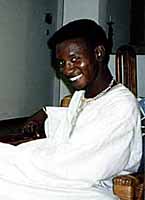 |
| Mohammed Diko is a Taureg artisan. |
Arising around 9 AM, we both felt well rested. We showered and explored the garden until Charlie came home for lunch. She'd scheduled her work this week so that she'd be home in the afternoon. After we shared lunch, we all went to Le Grand Marché, the big market by the water. Since we'd left our passports and couldn't cash our traveller's cheques, we shopped with our eyes. If we absolutely had to have something, Charlie had a little cash.
Going to the market is unlike any shopping experience I've ever had. Left and right, in front and in back, it's "Tsst, Madame! Regardez!" I was overwhelmed by the sights and sounds of hundreds of people — all wanting our attention! "Bien, bien, bien!" pressed a watch salesman as he trailed after Brian. The markets are usually run by women, the most successful of them known as Mama Benz, for the luxury cars they drive. Everyone was beautifully dressed, wearing a fantastical array of gorgeous commercial textiles.
There's barely room to walk ahead — the stalls dominate the market. Tsst, Madame! Charlotta took us to the Central building, which she'd never visited. 3 stories, it was filled with more stands. At every stall, women sat to the side of their products, all stacked precariously high. Those who didn't have stalls carried their wares on their head, such as the toothpaste lady who balanced a tray stacked with beautiful spirals of Colgate boxes. I got the impression that everyone was selling and no one was buying. Like the old adage about England, Lomé seemed a city of shopkeepers.
Toiletries and food dominated the first floor. Brian and I needed deodorant because we had accidentally packed a stick that was almost empty. Since none of us knew the right French word, Charlie made the international sign for "anti-perspirant," a rolling gesture under the armpit. The sales girl understood immediately.
We took the stairs and visited the fabric stalls. The walls had built-in cupboards for storing and displaying perfectly folded fabric. The women outside the Center Building displayed their wares under giant umbrellas. Symmetrical columns of brilliant textiles stood about 5 feet high.
Bargaining
The fabric is sold in units of pagne which is about 1 1/3 yards. One pagne can range from CFA 1,000 (pronounced say-'fa, equal to about US $1.75 at the time) to CFA 3,500 (US $6.14). Charlotta doesn't pay more than CFA 1,200 - 1,500 for a pagne. Bargaining is part of business and the shopwomen love to do it. Charlotta has a flair for it. If something is too expensive, she'll do the French pffff!, roll her eyes, furrow her brow and say, "Oh, Madame! C'est trop cher!" I'd like to learn how to say, "Are you shitting me?" If they haven't seen her before, they assume Charlie's a tourist. They don't realize she lives here and knows how much things should cost.
We found an ambiguous animal pattern I really liked. I actually saw a variation of it at the airport, worn as a shirt by a zemidjan (moped taxi) passenger. One shop keeper wanted CFA 5,000/pagne for it. Charlie said that was ridiculous. Sure enough, another had it for 2,500. That is, we haggled for that price. Brian also bought material, a muted pattern in beige and green.
In French, the woman asked if Brian was going to buy anything for Tante (me).
The market is almost too much stimulation. Tsst this and tsst that. The concept of "just looking" doesn't fly here. Eye contact is tantamount to "Sure, I'll buy something." That's a shame because everything was eye candy to me. I wanted so much to look at everything and everybody.
The Perfect Antidote
We were relieved to go home. I was exhausted. Charlie says Togo is Africa in your face. It's thrilling and overwhelming. Chicagoans were reserved by comparison.
Charlotta provided the perfect antidote to the day's overstimulation. She took me to her Monday yoga class at Priya's house while our husbands cooked dinner. A French teacher at the British School, Priya Doshi is one of the Copes' best friends.
The class of 4 students, including me, listened to the slow, clear French of the yoga teacher, Dennis. The word chakra is the same in every language. We did simple exercises and stretches accompanied by chanting sat na. It was perfect.
We came home to a delicious dinner of babaganouj, lasagna and beer. Back home, I rarely drink beer; in Africa, it is essential. Before dinner, Brian looked in the fridge and asked, "Are you saving the beer for a special occasion?" James replied, "No — any time you want a beer is a special occasion."
After dinner, we met Mohammed Diko, a Tuareg ('twah-reg') aritsan. The Copes had invited Mohammed to the house so he could show us his work in leather and silver. Mohammed's spotless white damask boubou glowed against his black, smooth skin. Around his neck hung a large silver medallion picturing an ancestor. (James though the sillouete looked like Queen Victoria!) How old was Mohammed? Who could tell? Twenty? Thirty?
The Tuareg are people of the desert and their intricate leatherwork is unparalleled. Brian and I loved the designs and placed orders for various things to be made in two weeks time. I think Mohammed's family could make anything and everything, from a cellphone case to a CD case. Thankfully, the haggling was more gentle.
I took my evening shower and went to bed. Slept like a rock.
•
|
previous | next: day 4
Those who didn't have stalls carried their wares on their heads, such as the toothpaste lady who balanced a tray stacked with beautiful spirals of Colgate boxes. |
|