 |
Day 4: Striking Out on our Own
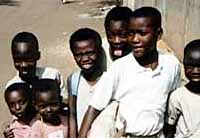 |
| I caught the eye of schoolchildren in the Kodjoviakope neighborhood of Lomé. |
After breakfast, Brian and I ventured to the bank and Le Grand Marché by ourselves. Charlotta instructed us to pay only CFA 500 for the taxi. Everything is an exercise for bargaining.
Economy of Scale
A trip to the bank was a good time to think about the west Africa's economy of scale.
The Europeans I met in Togo were well aware of their relative wealth. Most of them worked for foreign entitites and earned enough to save or invest. With the cost of living being so low, many foreigners find themselves living in luxury. Life being so high maintenance, many people had housekeepers to help with the daily chores that had to be done by hand.
At the same time, foreigners struggle daily to pay the fair price for goods and services. Taxi drivers, for example, often assume our friends, James and Charlotta, are tourists and would try to inflate their fees. Haggling is a way of life and perhaps, a form of entertainment.
Personal Shoppers
We walked a block into the market and a shop lady immediately caught my eye. In English she said, "Come and buy some fabric from me!" Looking at my skirt, she instantly knew I had a taste for the bright Dutch fabric.
Veronica introduced herself and showed me this and showed me that. Then I saw something I really liked — an indigo and white print of tomato plants.
Oh la la! she wanted CFA 5,000/pagne for it. I offered 2,500. Non. I said thanks but I'd continute looking. I was walking away when she called, "Madame! Come back! You have to talk about the price. That's part of the fun. We like to do that. I tell you, if you walk away, people will be annoyed with you!" She stood close to me. "Look, because I like you, I am going to give you a special price." (Everything's a special price, ain't it?) I offered CFA 7,000 for 2 pagne. Bon. We shook hands with a snap. Back home, that cloth would've been at least US $7/yard; here I spent about US $3/yard for something I've never seen in Chicago.
We hoped to find relief in St. Bartholomew Cathedral from the constant salesmanship. Before we could enter, we were stopped by a strangely beautiful child begging in front of the cathedral. She didn't look Ewe; her brown face was very narrow with straight hair. Brian gave her a CFA 100 coin and she took it wit a mute curtsey. I hissed, "Brian! Not cool!" We entered the cathedral. Quiet. Shhh. Prayer and peace. As we exited the cathedral, a boy looking just like the little girl ran up to Brian. Time to move on!
We escaped the main market and found a shop that sold prête a porter. The shop was owned by a friendly fellow named Barboza Messanh and he had about 6 men hanging out in the shop. I had no clue who actually worked there, aside from Barboza, but they all got in on the action. With the help of a crowd, Brian finally chose 3 outfits for his nephews and niece. Little did we know that Barboza would become a fixture of our shopping adventures.
Peace Corps
After the market, our next stop was at the Peace Corps office. First, Brian chatted with Margaret Diop, the director. A native of California, Margaret Diop spoke energetically about her life-long committment to Africa. She was leaving the Peace Corps in 2 months and was making plans to continue her work in Africa. Her life in Africa was not limited to her work; she and her Senagalese husband were raising two sons. This facet of her life facinated me. I could only imagine the challenges of raising bi-continental sons.
We went down the hall to meet Tchao Bamaze, the Associate Director of Health and Education. We talked about work and why Brian and I were in Togo. Tchao urged us to get out of the city and visit at least one of Togo's neighbors. Tchao shrugged when we asked him what he thought of Cotonou, Benin. It seems Cotonou is a point one passes through; it's not the final destination. Before we left, we accepted his invitation for drinks at his house that Saturday.
We left the Peace Corps compound and walked down the dusty road. We were just about to get into a cab when a group of school children walked past us. They caught my eye and returned my smile. When they saw my camera, it took no prompting for them to move into a pose! It was like a choreographed dance — small ones in the front and big ones in the back. (I made a note to myself to bring a Polaroid camera with me on our next trip to Africa. Children love pictures of themselves.)
Haute Couture
After a late lunch with Charlie, we all went to visit to Michel, one of the best tailors in Lomé. For those living in Africa, knowing a good tailor is compulsory. The Togolese dress beautifully; they wear both Western-style clothes and custom-made African clothes with equal ease. We were there at the end of the dry season and the average temperature was 99 degrees Farenheit. Synthetics are unthinkable; cotton and linen are essential.
The taxi dropped us off in the middle of a dusty street in front of an unremarkable building. Michel emerged and greeted us cheerfully. He was in his late 20's-early 30's and remarkably lean and muscular. How does a tailor get so ripped? The truth is, I saw all sorts of boys and men with musculature that many Americans — excluding those whose work is more laborious — can only develop at health clubs.
We entered the workshop and saw Michel's two apprentices working at shiny black machines operated by foot pedals. Imagine! Independence from electricity.
Michel examined our fabric, some of which we purchased in the States. We were fortunate he agreed to make copies of the clothes we'd brought; as a successful tailor, his work was in great demand. He was especially intrigued by the 1940's couture jacket I'd found at a resale shop in Chicago. The style was exquisite but the waist was tiny and bust line was too high. My friend Janet once described such bustlines as "Cold War Breasts, one pointing to DC and another to Moscow." He would copy the jacket and adjust the fit for my torso.
Evening
Back at the house, Glyn and Pheretha Thomas dropped by to say hello. Glyn is a Brit (half Welsh, thank you) who teaches with James at the British School of Lomé. His Liberian born wife, Pheretha is a manager at Sabena Airlines. Their 2 year old son, David Henry, was beautiful! Glyn is a very relaxed kind of dad — he gave David sips of beer!
After dinner, we played Scrabble with James and Charlie. It did not bode well for us when James began with a 7-letter word: slotted! Mr. Chips (James) won followed by Mrs. Fun (Charlie); Mango Girl (me); and Mango Boy (Brian). Brian and I love Scrabble and we're more competitive than we let on. I could tell Brian found it especially galling to lose to his friends who play only a few times a year!
I made the mistake of not showering before bed. I was hot and sticky and lay awake for hours. It wasn't until Brian got up at 5:30 to go running did I realize that I had gotten some sleep. I promised never to repeat my mistake. Frequent showers are essential for survival here! •
|
previous | next: day 5
"Madame! Come back! You have to talk about the price. That's part of the fun. We like to do that. I tell you, if you walk away, people will be annoyed with you!" |
|