 |
Day 11: La Port du Non-Retour
 |
| La Porte du Non-Retour |
We awoke at 4:30 to the sound of thunder and rain. The morning rains are much more frequent as we edge into the wet season. I stepped outside briefly and got my ankles chewed up in 30 seconds. Charlie had said that ankles were filet mignon to mosquitoes.
A few hours later, the four of us dodged the raindrops and had breakfast in the covered outdoor restaurant. Breakfast was simple but wonderful with fresh bread, muffins, tea, honey and pineapple marmelade.
I was sorry to see it still raining because the beach was so pretty. It would have been lovely in the sunshine.
la Porte de Non-Retour
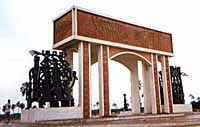
We packed our bags and headed back up the nasty road. In daylight, the road was less horrid — almost pretty. We stopped at the end of la Rue des Esclaves to visit la Porte de Non-Retour. Built in 1992, it is a monument to the slaves torn away from the country two hundred years ago.
The monument consists of an enormous arch flanked by two modern bronze sculptures. All this is centered on a large round dais, raised a couple feet off the ground. The arch is covered with bas relief on both sides. At the top of the arch facing inner land, the bas relief shows 2 rows of humans, hands chained behind their backs, converging towards a waiting slave ship. Viewed from the other side facing the beach, the bas relief shows the same figures, viewed from the front. Their faces are distraught. Behind them is a palm tree, a symbol of their home and lost freedom. Studded along the supports are bas reliefs of slave pairs, a man and a woman.
The modern brass sculptures are ribbon-like anthropomorphic figures representing slaves. On the left, if you are facing the beach, 3 figures stand with their hands chained all together. On the other side, a family huddles close together with one of the adults covering the head of the child.
The dais is edged with painted fetishes. Two brilliantly hued fetishes stand facing the beach, flanking the monument along the edges of the plaza. They are about 6 feet tall and their color contrasts the neurtral cream and terracotta of the arch. A poured cement heart, measuring about 10 feet square, sits to the left of the plaza, its 2 foot edge encrusted with shells.
I was moved. The monument was visually striking and its sentiment was powerful.
We enjoyed the drive up la Rue des Esclaves. This time we could enjoy the giant fetishes that dotted the road all the way back to town. I loved the chameleon and the Amazon; the Dahomey King's female guards were his fiercest and bravest soldiers!
Yovo, yovo!
I knew I was a foreigner but I never imagined having it constantly pointed out to me. In some places, white people have to put up with chanting children: Yovo! Yovo! Bonsoir! Ça va bien? Merçi! And since Brian was my constant companion, I heard this a lot in Ouidah. If you smiled and talked back at the kids, they'd shriek with laughter.
I wonder what children would chant to non-white foreigners traveling alone. "Yovo" means either "white person" or "foreigner."
The driving in town was dicey. The road construction combined with recent rains made the roads all but unnavigable. After an aborted visit to the museum (closed for siesta), we stopped for lunch at Hôtel Oasis.
Bush Taxi 101
Brian and I were excited about the next phase of our trip. We were continuing our travels alone. Charlie and James dropped us off at the intersection near Hôtel Gbena. Our friends waited until we secured a taxi before they turned back to the Togo border. We were on our own!
All throughout Africa, bush taxis are a form of public transporation. For long distance trips, taxis pack as many humans as possible into the car. Ancient Peugot 504s are the most common cars used for taxis. It's a wonder the cars stay in one piece. No safety belts, undependable doors, and tricky windows.
We agreed on a price of CFA 400 par tête to Cotonou. Brian and I sat in the back of the black Peugot 505. The driver quickly picked up 2 more women, who shared the front seat. I was startled to see that the passenger door wasn't properly closed and alerted the driver. The driver pulled over to the side of the road and leaned across the passengers to re-close the door. Suddenly a group of men appeared on the driver's side and thrusted their hands into the driver's face!
The strangers struggled with the driver for control over the wheel. They almost bent the key. An imposing man in a red shirt approached the taxi. The men argued and gesticulated vigorously until our driver was forced to leave the car. Big Red Shirt took over the car and moved it off the road next to a small building by the road.
"Monseiur!" we asked. What is going on? He imperiously turned and showed me a laminated pass that hung from a chain around his neck. "Je ne suis pas 'Monseiur'!" Oh, so he was someone important.
The area where we'd stopped seemed to be the taxi union office. We gathered that our driver was behind on his dues and the union decided it was time to collect. Money exchanged hands, receipts were written and we were finally on our way to Cotonou.
Night in Cotonou
The remainder of the ride was uneventful. We arrived safely in Cotonou and our driver deposited us near Blvd St. Michel. Cotonou traffic is amazing; we couldn't believe the quantity of zemidjans clogging the streets.
We needed to find a room and had a couple hotels to check out. We walked south to Hôtel Camer. The room there was barely large enough to accomodate the bed and, being on the ground floor, felt like it was practically on the street.
We then looked at a room at Hôtel Babo, famed from being cheap and relatively clean. We liked what we saw and took a third floor room with a fan, shower, and WC for only CFA7,000. A sign on our door instructed guests not to cook or do laundry in their rooms. So how does one explain all the laundry lines criss-crossing the windows?
Freshly showered and perfumed with mosquito repellant, we walked down the street to Senegalese Restaurant L'Amitie. I had yassa mouton and Brian ate some sort of fish that was more bone than fish. The bottled water was my favorite part of the meal. Brian, on the other hand, always enjoys his food. We had a beer at the bar next to the hotel where a television played the American soap opera Santa Barbara, dubbed in French.
We walked slowly around the block, enjoying the side streets, dimly lit by interior lights from tailor shops, small food stores, and bars. Our guide book said that Cotonou no longer had any movie theatres since the introduction of VCRs. We saw a corner "video theatre" with rows of chairs in front of a TV. I can't imagine that has helped the African film industry. While Brian and I enjoy our VCR, nothing will replace the experience of going to our local movie house. In fact, we purposefully chose to live within two blocks of a movie theatre.
On Blvd St. Michel we saw an anti-smoking billboard lying on the sidewalk. It's message was so forceful: Le tabac appauvrit la famille. Fumer, chiquer ou priser le tabac c'est brouler son argent et sa sante. Tobacco will impoverish the family. To smoke, to chew, or to snuff tobacco is to burn your money and your health.
We finished the night writing in our rooms. I was writing in my journal when a saw something from the corner of my eye. I turned and saw an enormous cockroach scuttle across the room. It was the length of my thumb and twice as thick. I couldn't rest until Brian vanquished it with my sandal. I'm no different back home. I love spiders but I cannot abide cockroaches and earwigs. Uggghhh!
Before we went to sleep, Brian and I decided we'd take the train north to see the Royal Palace of Abomey. Anything else was up for grabs.
•
|
previous | next: day 12
two rows of humans, hands chained behind their backs, converge towards a waiting slave ship |
Suddenly a group of men appeared on the driver's side and thrusted their hands into the driver's face! |
A sign on our door instructed guests not to cook or do laundry in their rooms. So how does one explain all the laundry lines criss-crossing the windows? |
|