 |
Day 12: Bush Taxi from Hell
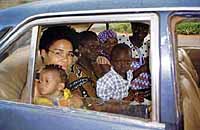 |
| How many people fit into a Peugot 504 bush taxi? Try nine. |
We slept under ceiling fans and awoke after dawn. Since neither of us brought rain gear on this trip (the only thing we forgot), we had to wait 30 minutes for the morning rain to stop. We walked down a side street, south-east towards the train station. Oddly, we ended up walking by the sewer. While it didn't smell so bad, it looked bloody awful.
An old man walked past me and said, "Bonjour, ma belle seestah!"
Cotonou-Parakou Train
At the train station, we paid CFA 1,500 each for first class tickets for Bohicon. Bohicon is 8 km from Abomey, our actual destination. Abomey, 144 km north of Cotonou, was once the capital of the Dahomey kingdom. The kingdom had been enriched by slavery; prisoners of war were sold to the British, Dutch, and French for the modern tools of war: guns and cannons.
The train ride was delightful and the accomodations were clean and cool. At first Brian was afraid we'd be the only people sitting in our compartment. The notion of traveling second-class was romantic but impractical; those compartments were packed like Japanese trains during rushhour.
Fortunately, we were soon joined by other travelers. Luc, for example, was an oil businessman. Dressed in a pressed blue oxford shirt and jeans, he was eerily free of perspiration. He was delivering a moped to his cousin in Parakou, the last stop on the line. He spoke good English and was very gracious.
Luc and some other passengers got into a friendly but heated debate about who had the best hospitality in West Africa. Luc felt one couldn't make sweeping statements like that. Having traveled all over the world and 23 African countries, Luc said, "There's always something good and bad about each country."
The ride up country took about three hours. It stopped frequently at cute, tiny stations where hordes of vendors with snacks on their heads rushed up to the windows and doors. Luc bought food at evey opportunity. I tried an escargot. It was very tough, like rubber. I bought a frozen treat from a train vendor: iced coffee tied in a tight plastic sack. You just had to bite the bag and enjoy. Perfect.
I enjoyed looking out at the countryside. We passed through farm after farm. In the middle of a field, I saw a tiny little boy wearing a bright red turtleneck with no underpants. At the train stops, children flirted and danced in front of my window.
As we neared Bohicon, Luc introduced us to a friend connected to Hôtel Dako, just 2 km south of Bohicon. We secured a room for CFA 8,000 and found a taxi to take us to the Royal Palace and Museum.
Bush Taxi from Hell
Brian and I packed into the taxi, which was really a shitbox on wheels. The car had seven passengers plus a driver. At one point, the woman squashed in the passenger seat with Brian, turned and asked me to hold her baby. I was glad to; the mother, Bertie, was practically sitting on the stickshift. The baby sat quietly in my lap while she hung on to my necklace like a train commuter. The baby was wonderfully soft and brown; her eyebrows were lightly penciled too.
After Bertie and her baby descended, it started raining quite hard. The windows couldn't close and the windshield wipers had been exhausted years ago. The rain slanted into the car at a 45º angle. By the time we arrived at the autogare, my the entire right side of my body was soaked. People standing under cover from the rain watched and sniggered as I struggled to open the car door.
I flopped back in defeat and said to Brian in English, "Okay! F*** it! Let's get to the museum already!" I was in a sour mood when we arrived at the museum. Not only were my clothes wet but the museum guy said we should have paid only CFA 250 per person for the taxi. We'd paid 500.
The truth is that it's pointless to stay mad. My anger quickly evaporated like the damp of my clothes. We waited quietly; the museum would re-open once the rain stopped.
The Royal Palace of Dahomey
From its founding in 1620 to the placement of a puppet king in 1894, the Kingdom of Dahomey was the region's most powerful military and economic force. Enriched by the slave trade with the Americas and Europe, the Dahomey bought the latest war technologies.
UNESCO has designated the Royal Palace of Abomey a World Heritage Site. At one point, the walled palace covered 40 hectares — almost 90 acres! (One hectare = 10,000 square meters = 2.47 acres.) Each successive king built his own palace. Upon his death, the palace was transformed into a funeral temple.
Today, only a few buildings remain; the rest was burnt in 1892 by the Dahomey during war with France. UNESCO has marked the Royal Palace as a world treasure and much effort goes into its conservation.
I found the propagation of slavery to be the most uncomfortable aspect of this military culture. Human cultures all over the world have practiced slavery or indentured servitude of one form or another. Africa was no exception and slaves were generally prisoners of war.
What's particularly grim is that the Dahomey Kingdom, like the antebellum American South, economically depended on slavery. Once the Kingdom expanded to the coastal city of Ouidah — the region's only port — the Dahomey monopolized the slave trade. They conducted military campaigns to expand the kingdom and to capture prisoners of war for export.
The European and American slave trade could not have succeeded without the complicity of Africans. That idea is not very popular in the States and most students don't learn of it until college.
The Royal Palace wasn't all sturm und drang. The Dahomey kings were great supporters of artisans. I loved the appliqué and bas reliefs which were used to illustrate military triumphs or royal history. Other intriguing artifacts included jewelry, weapons, and clothing.
Evening
After haggling at the autogare (a process which was beginning to wear me down), we got a cab back to Hôtel Dako. Our room had a WC, shower and even AC. No toilet seat but everything was clean. Funny thing about the toilet seats. Most of the WC's didn't have seats. And if they did, they usually didn't fit. At the Copes' house, for example, their toilet seat hung off the edge a good 3 inches — one false move, and you're in the bowl!
Brian enjoyed a few laps in the pool which he shared with African Swallows. The birds dipped their wings in the water as they skimmed across the surface.
We dined at an eaterie across the street. More bones with our sauce. Brian had some ghastly fried cheese. Please don't think I'm an ignorant sod raised on an American diet of Wonder Bread and crackers. I grew up on my mother's delicious Amer-Asian cooking. My favorite restaurants in Chicago are Ethiopian and Vietnamese! Up to that point, the best West African cuisine was had at Tchao Bamaze's house, Lomé's Keur Rama restaurant and the food stand in Forever. Otherwise, water was generally the best part of our Togolese and Beninoise meals.
After dinner, we had beer at the hotel bar while watching television obituaries. The obituaries featured photographs and text describing the deceased people. Some of them had been dead for decades, still honored and remembered by their families.
Before we retired, the man behind the counter said he'd get a taxi for us the next morning, returning to Cotonou. My hope was to visit Ganvié, a village built on stilts in the shallow Lake Nokoué. To reach the village, one had to go to the disembarkment point in Abomey-Calavie, 18 km or 25 minutes away from Cotonou. According to our map, it looked like the main highway ran right through Abomey-Calavie. The problem would be finding a taxi willing to take us there.
When we got back to our room, we reeled at the stench of Brian's mildewy shorts. They got wet the day before at Mon Pied Ton Pied and were taking days to dry. Whew! We plugged our noses and went to sleep.
•
|
previous | next: day 13
Having traveled all over the world and 23 African countries, Luc said, "There's always something good and bad about each country." |
The windows couldn't close and the windshield wipers had been exhausted years ago. The rain slanted into the car at a 45º angle.
|
Human cultures all over the world have practiced slavery or indentured servitude of one form or another.
|
|