 |
Day 13: In search of Ganvié
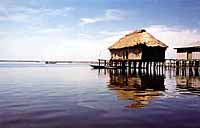 |
| Ganvié is a village built in the middle of a shallow lagoon. |
We were out of our room by 6:30 am. The promised taxi never showed up; the hotelier must have been humoring me. We started walking towards the autogare which was about a half hour walk. When we asked a man for directions to the autogare, he encouraged us to go back in front of the hotel. "You can catch a cab going south," he assured us. But all the taxis driving by were stuffed with passengers so it was back to the autogare.
We enjoyed fresh hot fried dough for breakfast from a streeet vendor. We saw zemidjan with three school children clinging to the driver (one in back and two in front).
We chatted with a taxi driver who was working on his car on the side of the road. "Is it possible to get a taxi to Ganvié or Abomey-Calavi?" He said, vigourously chewing a cleansing stick, "You must go all the way to Cotonou first and then go back up to Ganvié." A ridiculous idea but we were resigned.
We found a taxi to take us to Cotonou though, in truth, it the taxis that find you. Brian and I shared the front seat of another Peugot 505. It seems all taxis come with a little wood box at the foot of the passenger side — a footrest for the poor bastard (me) sitting on the stickshift.
The ride was very pleasant. I rubbed and massaged my numb buttocks when needed and rode without too much discomfort. The weather was unbelieveably gorgeous! Our driver was good humored and professional. When we narrowly missed nicking a kid goat bolting across the road, our driver chuckled, "Il a bonne chance!" (He's lucky!) Yes, especially since the driver didn't slow down one bit.
My favorite image was the sight of five people on a moped: a child in the front, the driver, another child, the mother, and a baby strapped to her back!
When I saw the road sign for Abomey-Calavi, I knew we had a chance to go straight to the debarkment point for Ganvié. The driver was agreeable and took us to the lagoon. We still had to pay the full CFA 1300 per head but we had the convenience of being exactly where we needed to be.
Ganvié: the Venice of Africa
Ganvié was founded in the 18th century by the Tofinu people who migrated south when their land no longer supported them. They found refuge in Lake Nokoué's shallow water. The lake allowed aquaculture to flourish and the Tofinu were safe from agression from the Fon and the Dahomey, both who had religious prohibitions against crossing water. In the Tofinu language gan means "we are saved"; vié means "community."
It was around noon when we arrived at the lagoon. The sun was high and we were grateful for our hats. We paid CFA 3,000 to be carried across the lake by pirogue, a dugout canoe. (In the States, the very same pirogues are used by Cajuns and Acadians, both decendents from the French Acadians who first settled Novia Scotia in 18 somthing.)
Our guides were Nobert and Gregoir, in the stern and bow respectively. It took 45 minutes to cross the lagoon. We saw other locals paddling to the village. In the distance, we could see people standing in the chest-high water as they worked. The Tofinu use several methods to breed and catch fish. We saw people using a network of underwater fences called akadja. We also saw two Americans — a young hatless, red-faced couple taking a year-long sabbatical from grad school in Boston.
The pirogueurs glided throughout the village with 3 stops for shopping and drinks. In the village, the water was only about 3 feet deep; Children as young as five were paddling their own pirogues using oars with blades the size of my palm!
Ganvié is a prime example of how tourism has helped and harmed a community. The villages get only fraction of the pirogue fees; hotels and cafés gain the most. Tourism has also spawned a culture of of giving cadeaux. Some children who saw us stuck their hands out, chanting cadeau! cadeau! Other children flashed us smiles as they worked or played.
I would love to have a group of Tofinu meet with a group of Venicians to talk about how tourism has affected their culture. It must be bizaare to have foreigners endlessly traipsing through your neighborhood, photographing your laundry and your children.
The whole tour took about 2 1/2 hours. Our only error was under-tipping our pirogueurs. James later said CFA 1,000 to 1,500 is approriate for a tip; we had tipped 500. I felt shitty about it but Brian didn't want to go back to make up for our error. I felt worse about being a cheap bastard than I did about getting ripped off. It's part of the "representing America" complex. Brian, who had lived in Africa for over 2 years, said one just learns and does the right thing next time.
We quickly caught a taxi to Cotonou for CFA 725 per head. This was our first taxi that wasn't all crapped out, which is why the broker must have tried to hard to get higher rates. Less than half an hour later, we were back in Cotonou and pulled into the autogare for taxis leaving for Lomé. The car hadn't even stopped yet before drivers and brokers stuck their heads through the window trying to lure us to their taxis! Our driver was indignant and rightly demanded that he be paid first.
We secured a taxi to Lomé which we shared with a trio of Ghanaians. The Ghanaians complained bitterly that they were being overcharged for their fare to Ghana, which is 10-20 km from Lomé. Once they settled their fare — everything is negotiable here — we all packed into the car. Brian and I shared the front seat and the Ghanaians — a couple in their twenties with a middle-aged woman — sat comfortably in the back. Only five passengers!
Our driver was Catholic and crossed himself before he started the car. Three more hours and we'd be back in Lomé!
Mango Fever
The highways are dotted with roadside foodstands. This being mango season, the fruit was available everywhere. When our driver stopped to buy a sack of 9 mangoes, Brian asked me if I'd like some. "Nah. They'll be too messy," I said.
Our driver proceeded to eat eight mangoes one after the other — while he drove! First, he spread a cotton cloth across his lap. He pulled a small yellow mango out from its bag and gave the fruit a prefunctory polish on his lap. He held the mango in his left hand as he steered with his right. His first bite opened the mango. He chewed at the skin and thhrlopped it out the window. He then proceeded to gnaw and suck at the fruit down to its hairy pit.
He did this 8 times, devouring each voraciously. He did not eat his 9th mango; that was for later. After the 8th mango, our driver vigorously sucked his teeth for 10 minutes.
At another quick road stop, he discouraged the Ghanaians from buying food. They were having trouble making change and the driver was anxious to keep driving. The young male Ghanaian complained, "Why get angry at us! You get to mango chop and we don't get to chop!" The driver grudgingly said they'd have time, closer to the border.
True to his word, our driver stopped at a bridge near the border. A group of women were selling prawns and various sweets. The Ghanaians chopped and everyone was happy.
Border Crossing
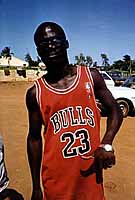 The border crossing went smoothly. Africans seem to glide through the process while foreigners take longer to go through the system. A Chicago Bulls fan allowed me to photograph him. The Beninois inspectors were funny and good humored. The fatherly one was intrigued by my last name, Kachama-Nkoy, and smiled at my horrible passport photo. When I asked to use the toilet, the female inspector joked I'd have to pay her CFA1,000! I did a double-take and we all laughed. On the Togolese side, another female inspector gravely greeted me with "Ça va, ma soeur?" The border crossing went smoothly. Africans seem to glide through the process while foreigners take longer to go through the system. A Chicago Bulls fan allowed me to photograph him. The Beninois inspectors were funny and good humored. The fatherly one was intrigued by my last name, Kachama-Nkoy, and smiled at my horrible passport photo. When I asked to use the toilet, the female inspector joked I'd have to pay her CFA1,000! I did a double-take and we all laughed. On the Togolese side, another female inspector gravely greeted me with "Ça va, ma soeur?"
A self-appointed guide helped us find our taxi on the Togolese side. Not quite out of the border crossing, our driver jumped out of the car and ran to the roadside to talk with soldiers. "What is he doing?" someone asked. I answered, "More mangoes maybe!" Everyone tittered.
Reuse and Recycle
It was only another 45 minutes to Lomé and our driver dropped us off downtown, a couple blocks from Keur Rama restaurant. I was about place an empty mineral bottle in a garbage can when a woman sitting nearby clucked her tongue at me. I dutifully brought the bottle to her and also gave her an empty glass bottle with a rubber stopper. The glass bottle once held peanuts but its label said it had contained Ringer's lactate.
While the Togolese love automobiles as much as Americans, they have a completely different view towards recyling. Every — and I mean every — glass and plastic bottle is reused. In 16 days, I never saw any broken glass. While driving through small towns, we saw petrol stations selling fuel in large beer bottles! There is almost no broken glass in all of Lomé. Every freaking bottle, plastic or glass, is reused. A traveler from Lomé would be appauled by the litter in Chicago or any American city.
We were so pleased to back at "base camp." James asked, "Did you have any adventures?" Yes. "Any hassles?" Yes. "Good! It would've been rude not to!"
We devoured our dinner that night and slept like stones. •
|
previous | next: day 14
My favorite image was the sight of five people on a moped: a child in the front, the driver, another child, the mother, and a baby strapped to her back! |
It must be bizaare to have foreigners endlessly traipsing through your neighborhood, photographing your laundry and your children.
|
"Why get angry at us! You get to mango chop and we don't get to chop!"
|
|